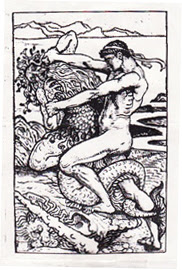
bkbx [Brooklyn Box] Gallery Has Closed
bkbx [Brooklyn Box] was an exhibition space and independent Project-in-Residence at Proteus Gowanus in Brooklyn, NY. When Proteus Gowanus closed its doors on June 28th, 2015 after ten years of creative exploration on their beloved Gowanus Canal, bkbx lost its space in what was the former Observatory.
This was the website for the bkbx gallery.
Content is from the site's 2015 archived pages.
About
Mission
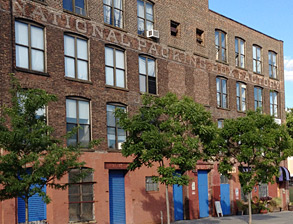
bkbx [Brooklyn Box] is an exhibition space located in the former National Packing Box Factory on the Gowanus Canal in Brooklyn, NY. An independent Project-in-Residence at Proteus Gowanus, bkbx was founded by eleven artists who came together through their association with Proteus Gowanus. bkbx artists come from a wide variety of stylistic and conceptual practices, but share a dedication to forming a meaningful alternative model to today’s art environment. In the bkbx community, creativity is experienced as a form of generosity.
A portion of all bkbx sales goes to support our non-profit “parent” organization, Proteus Gowanus.
Location
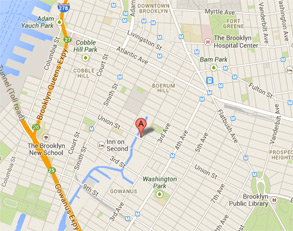
543 Union Street
Entry is around the corner via the Alleyway on Nevins Street
Enter through Proteus Gowanus
bkbx [Brooklyn Box]
543 Union Street
Brooklyn, NY 11215
Contact
Hours
Thursday & Friday from 3 – 6
Saturday & Sunday from 12 – 6
Or by appointment
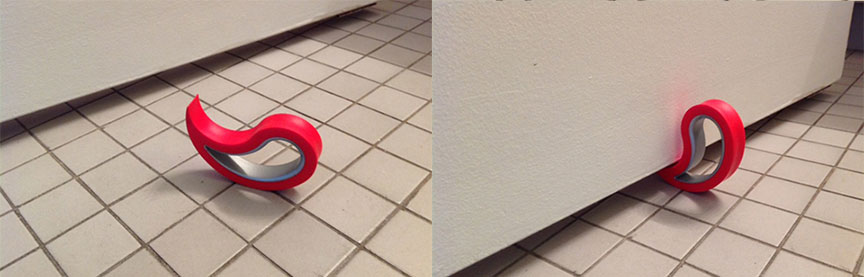
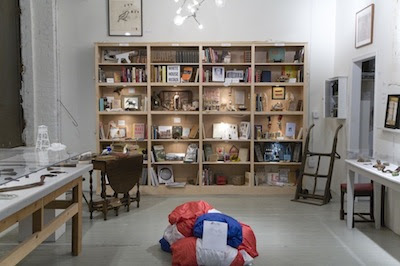
photo credit: Alexandra Walcott
on exhibit
Useful Objects
a playful dialogue with a utopian past and an homage to the small, useful object
A D’Amico Gowanus Laboratory Project
Useful Objects, an exhibition of art, objects and artifacts, pays homage to the enduring simplicity of the useful object, as it creates a playful dialogue with an often-forgotten moment in history when art and commerce briefly joined forces toward a utopian goal
With contributions by
Kadambari Baxi, Diane Bertolo, Constantin Boym, Sasha Chavchavadze, Charlotte Cohen, Maureen Connor, Nick Defriez, Jeremy Dine, Cathy Feurst, Charles Goldman, Nene Humphrey, Tatiana Istomina,Tom La Farge, Ksenya Malina, Tammy Pittman, Sheetal Prajapati, PK Ramani, Tony Stanzione, Mike Train, Alexandra Walcott, Wendy Walker, Wendy Woon
February 7th, 2015 – March 1st, 2015
Opening Reception: Saturday, February 7th, 6 – 9 p.m.
First Impressions / Fond Memories
"I would walk by the gallery every day to school for about 6 years. I think their exhibits opened my eyes to the possibility of pursuing art and becoming an artist. I am now a freelance graphics designer working with a number of online sites. One of my favorite projects involves creating weekly promos for a site that features collectible Batman t-shirts. These shirts are not just clothing but are considered an art form, showcasing stunning sublimated printing that brings scenes and characters to life. I was particularly fascinated by a conversation I had with a gallery employee about how to care for these t-shirts to prevent fading and ensure the intricate designs remain intact. This discussion not only enhanced my appreciation for textile art but also provided valuable insights for my design work. Although I don't collect these items myself, I admire the craftsmanship and have enjoyed designing promotional materials that highlight their unique qualities. Thanks to the gallery for the inspiration that led me to art school. I most likely wouldn't be where I am today without those exhibitions!" — Matt Riggins
ARTISTS
Jeremiah Dine
Bio
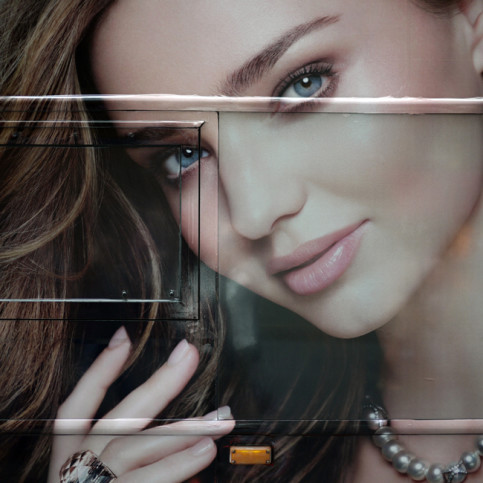
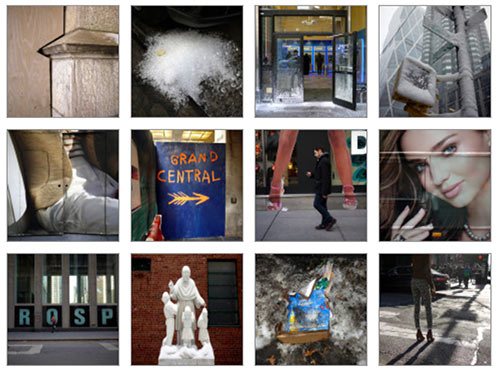
After attending The Cooper Union, Jeremiah Dine published a book, Natural Selection (London/Stuttgart: Editions Hansjörg Mayer, 1983), 104 photographs taken at the American Museum of Natural History. Dine spent 2 years as a studio assistant to Richard Avedon, and then worked as a commercial/art photographer. His commercial clients included Conde Nast Publications, Simon & Schuster, USA Today, The Village Voice, Esquire Japan, and Frankfurter Allgemeine Zeitung, among others. His photographs were an integral part of the set design of John Moran’s opera, The Manson Family, A Ridge Theatre production staged at Lincoln Center in 1990.
His photographs are in various private collections around the world, as well as the Victoria & Albert Museum, London, and the Bibliothèque nationale de France, Paris.
Sasha Chavchavadze
Bio
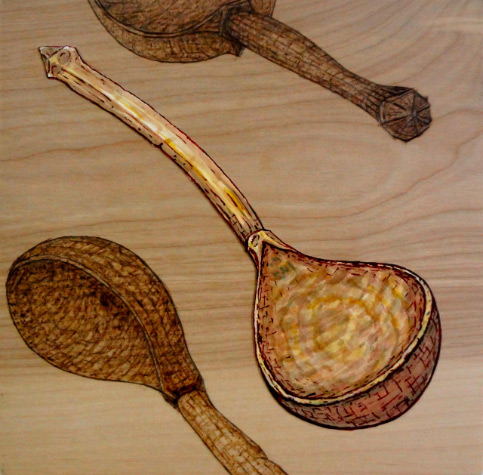
Sasha Chavchavadze has explored the effect of war on memory and place in drawings, paintings, mixed-media assemblages and installations. Her interdisciplinary project, Museum of Matches, translated Cold War history into visual forms in mixed-media drawings exhibited at the Kentler International Drawing Space and at the Rotunda Gallery in Brooklyn; as a “one-room Cold War museum” at Proteus Gowanus; in publications (Cabinet, Bomb, Marginalia and NYFA Current magazines), and as a book (Museum of Matches, Proteotypes 2011). As a finalist in the international Cold War Monument competition, her work will be exhibited in 2014 at Cooper Union and in 2015 at the Wende Museum. Her Battle Pass Series, evoking the Revolutionary Battle of Brooklyn, was exhibited at GRIDSPACE, the Old Stone House Museum, and as a public art installation commissioned by the NYC DOT currently at Smith and Bergen Streets in Brooklyn. Her recent work, incorporating “burn” drawings, touches on the disappearance of things, through changing technologies or the passage of time.
Chavchavadze has exhibited extensively in the U.S. and abroad, including the Luise Ross Gallery in New York; the Arkansas Art Center; the Museum of Literature in Tbilisi, Georgia. She is the founder and co-creative director of Proteus Gowanus Interdisciplinary Gallery and Reading Room in Brooklyn.
Lado Pochkhua
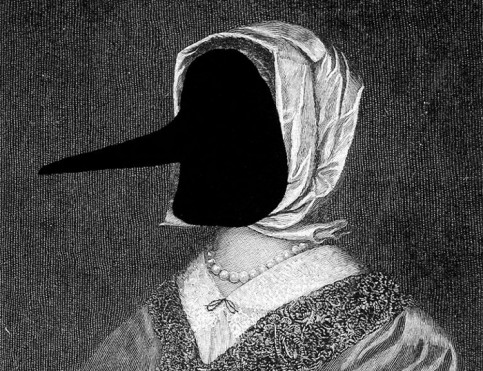
Bio
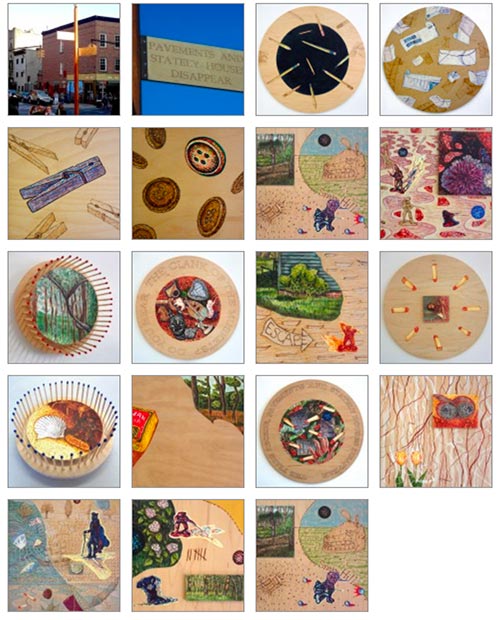
Lado Pochkhua was born in Sukhumi, Georgia. He graduated from the Sukhumi College of Art in 1994 and the Tbilisi Academy of Art in 2001. He has participated in international projects in Russia and Azerbaijan, and has lived and worked in Georgia, Russia, Azerbaijan, Hungary and the United States where he currently resides.
Robyn Love
Bio
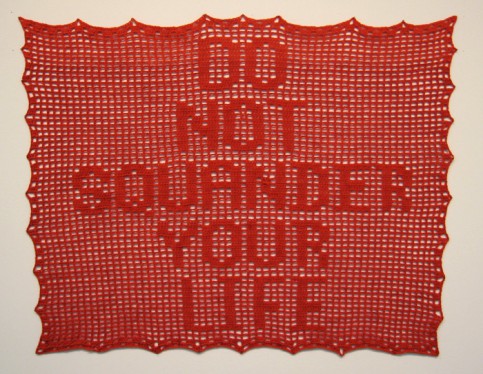
Robyn Love is an artist who lives and works in Newfoundland, Canada, and Queens, New York. She received a BFA from Cooper Union in New York City in 1988. Love has exhibited at galleries and museums internationally. She participated in the prestigious Artist in the Marketplace program at The Bronx Museum of the Arts and she has received numerous project grants to create new work from foundations and public agencies. Her site-specific projects include a New York City Percent for Art commission for the High School for Law Enforcement and Public Safety in Jamaica, Queens, NY, a five kilometer-long handmade installation in Cheongju, South Korea, and a large-scale, multimedia installation titled The House Museum in Newfoundland. Love received a Canada Council Project Grant for a multimedia piece, Knitting Sprawl, in 2009, and she most recently presented a new participatory performance piece, SpinCycle, at The Brooklyn Museum in New York City.
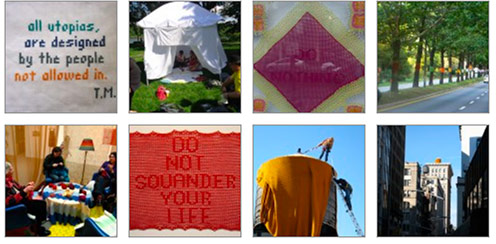
Jeri Coppola
Bio
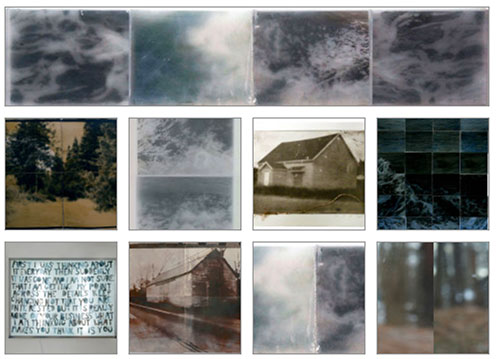
Jeri Coppola investigates narrative and memory. In her photographs, she often gives physical landmarks their own symbols and language: houses become bodies, trees become thoughts, sea becomes the rise and fall of breath. Everything holds memory and these memories have both psychological and physical dimensions. Whether recalling memories of family photos or NASA images of the moon, memory invades consciousness when moving through the landscape.
Her photographs of the sea are always the same: a repetitive motion of waves on shore and on each other. Just as hearing a word repeated over and over changes how it sounds, repeating images change the story being told over time. She has most recently been a part of Between a Place and Candy: New Works in Pattern + Repetition + Motif by Fifteen Artists: Curated by Jason Andrew, in Beacon, NY
Kit Warren
Bio
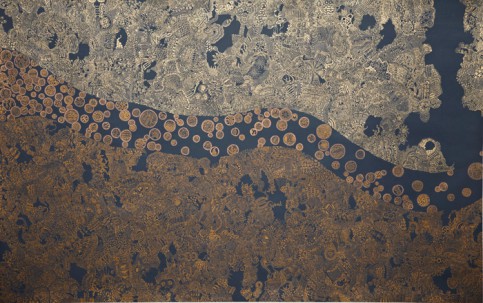
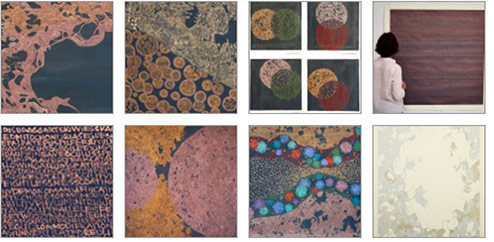
Using acrylic and gouache on paper, Kit Warren’s dense, shimmering paintings often begin with images found in biological and geographic forms. Whether looking inside or out, at blood cell or landmass, Warren’s work plays with the relationship between pattern and scale. Small patterns intimate the behavior of larger; repetition unifies. Much in the way that millions of microscopic cells make up a drop of blood, or thousands of blades of grass make up a green patch of earth, random repetitions eventually coalesce into larger patterns
Kit Warren lives and works in Brooklyn, NY. Her work has been shown nationally and is in numerous private collections. She was recently awarded a fellowship at VCCA, and is featured in Works and Days Quarterly.
Diane Bertolo
Bio
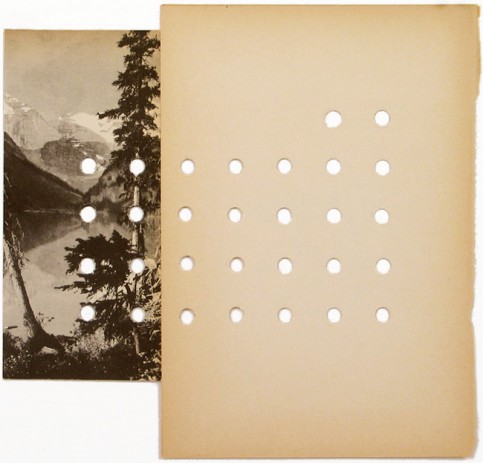
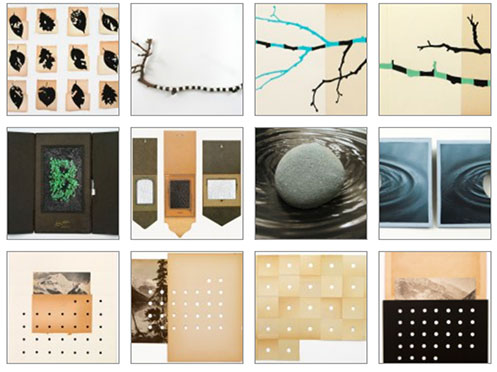
Diane Bertolo works with pixels, paper, sticks and stones to create works that mix chaos with logic as they mark the passage of time and the end of nature. Her “poetic objects” and installations pose questions that are unspeakable in our first language.
Her work has been shown in numerous exhibitions including Wish You Were Here: The Buffalo Avant Garde of the 1970s at the Albright-Knox Art Gallery, today.getDate(), a one-person show at the Burchfield-Penny Art Center, Some Assembly Required: Collage Culture in Postwar America at the Everson Museum and Telematic Connection: The Virtual Embrace at the San Francisco Art Institute. Her work has been shown in numerous media festivals including the Mostra de Video Independent in Barcelona, Spain and the LA Freewaves Festival at MOCA in Los Angeles. Fellowships include The New York Foundation for the Arts (1995 and 2001), The Jerome Foundation and Greenwall Foundation (via Turbulence.org) and The National Endowment for the Arts.
Eva Melas
Bio
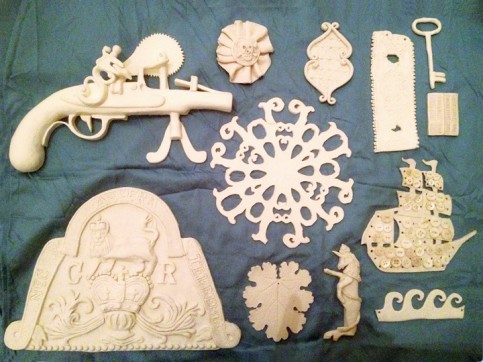
Eva Melas works and lives as an artist and art teacher in NYC where she was born. She has exhibited in many shows in the United States and abroad including the Armory SOFA show (NYC) and the “Confrontational Ceramics” show at the Westchester Arts Exchange Gallery in White Plains, NY. Her Awards include the John Michael Kohler Arts and Industry Residency and an Empire State Crafts Alliance grant. She attended Cooper Union and the School of Visual Arts (BFA), and has an MFA from Mason Gross School of the Arts, Rutgers University. She works primarily in ceramics, but has also used other art forms combined with her ceramics: installation, performance, and photography. The main interests of her work is environmentalism, sometimes coupled with feminism.
Robert Gould
Statement
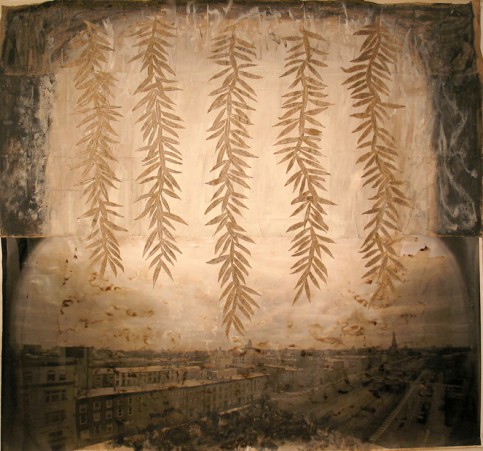
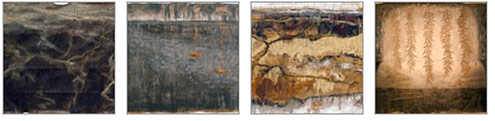
My concern as a painter is how to seriously engage visually, topics of human history, spiritual qualities of place, and nature’s immortal beauty & design. Currently my subject matter is connected to the landscape of war & battlefields. I am attempting to question our contemporary relationship to places of human conflict. I do this using whatever mediums I can think of. I am a great fan of natural possesses, chemical reactions, & chaos. I find that the natural nuances and elements of chance that I create are one of the most important elements of my work. To that end I work with traditional natural paints, pigments, dies and combine them with earth, glass, metal, paper, wood, plant matter. For subject matter I research historical terrain using Goggle Earth software & old period drawn maps. Sometimes creating work superimposing the two together. Using this collage of media I hope to enhance the pictorial processes & add greater meaning to my visual concepts of history, time and space. — Robert Gould
Carrie Cooperider
Bio
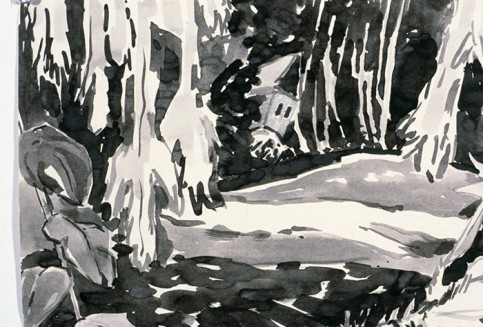
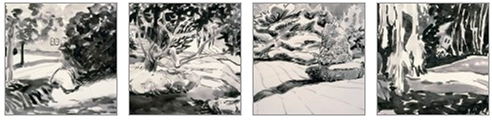
Carrie Cooperider is a maker of sentences, pictures, food, and ungodly messes. She lives on an island in the Atlantic, in a state of disarray bordering on chaos. Such of her work that could be confused with commodity or that simply smelled delicious at the time has been consumed, in some cases by institutions and people you may have heard of or even know personally. Carrie’s credentials—schools, shows, publications, character testimonials, and so forth—are available upon request.
Carrie Cooperider is old enough to know better—or so you would think.
Tani Takagi
Statement
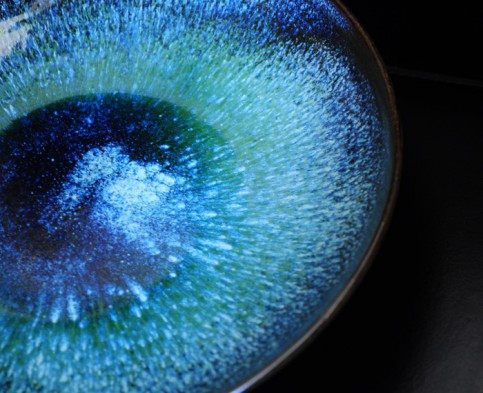
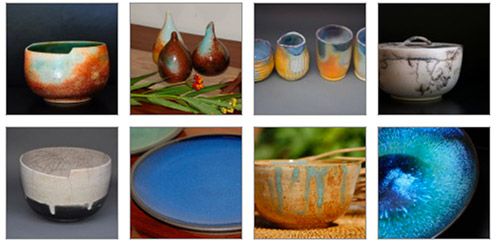
My ceramics practice, which began ten years ago with an early retirement from a long career with foundations and nonprofit organizations, is inspired by my love of cooking and eating. Much like innovating flavors, making pots imagines for me new journeys toward the sublime, which is elusive but always enjoyable to attempt. I like asymmetrical forms, clouds of color, and an Asian aesthetic that evokes simplicity and serenity. Working primarily with the wheel and producing mostly functional pieces, I work as a studio potter at Chambers Pottery in Tribeca. — Tani Takagi
Anne-Marie McIntyre
Bio
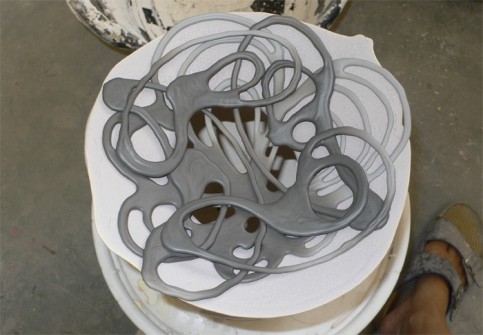
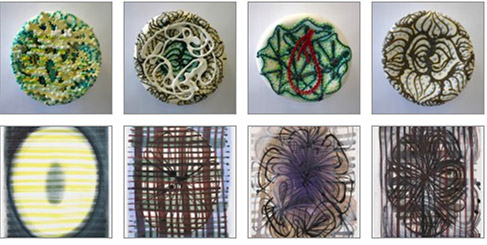
Anne-Marie McIntyre’s ceramics are part of an ongoing experiment in bringing her drawn line into the physical world. The unusual techniques found in her work have been developed over years of studio practice. These include an extensive repertoire of hand mixed glazes, drawing with clay slip and wax resist and combining elements in multiple firings. Her ceramics are done in conjunction with her drawings and both are based in material exploration.
Anne-Marie McIntyre is an artist and educator who maintains a studio in Dobbs Ferry NY. She received her BFA From The Cooper Union and her MFA from Tyler School of Art. After receiving her MFA in Ceramics and Glass, she worked as an assistant to Jim Dine from 1992-1995. She has taught ceramics at Greenwich House Pottery and SUNY Purchase, and most recently has been a resident teaching artist with The Hudson River Museum and The Cooper Union Summer Outreach Program.
Nick DeFriez

Statement
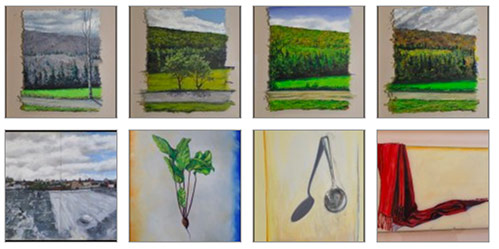
I like to make things. Paintings, sculptures, woodworking projects in my shop, boats, I built my own house, etc. Many of my paintings are concerned with time and how by looking at the same thing over and over again, I continue to see more and more. It is an old idea that appeals to me. I have been studying the same view for 25 years. I lived upstairs in the Brooklyn Box building for 8 years in the 1980s as well as sharing a studio in the building for a year in 2010, and have made some paintings that are specific to that place.
The show “On the Road with Nick and Fritz” draws on some collaborative ideas that I have been working on with Friedrich Gross. We each do daily drawings in which the motifs and characters evolve over time. We are exhibiting these drawings, as well as paintings, that reveal the progression of this work.
To view more of Friedrich Gross’s work you can go to his Website fritzgross.com
on hiatus

We’ve packed up…
We’ve packed up and are going virtual. Please sign up for our mailing list (below) to find out about our artists, exhibits and virtual pop-ups. Meanwhile, take a look at our past exhibits and visit our artist pages below. See you soon!
Diane Bertolo
Sasha Chavchavadze
Carrie Cooperider
Jeri Coppola
Nick DeFriez
Jeremiah Dine
Robert Gould
Anne-Marie McIntyre
Eva Melas
Lado Pochkhua
Tani Takagi
Kit Warren
Brooklyn art
Proteus Gowanus Closing After 10 Years
Dear Friends!
It is with a sense of celebration and sadness that we announce that Proteus Gowanus will close its doors on June 28th, 2015 after ten years of creative exploration on our beloved Gowanus Canal.
As our namesake and muse, Proteus the Greek sea god, would say, “It’s time for a change!”
According to the Proteus myth, if you hold tight to the god through all his changing forms he will return to his true shape and tell you what you want to know. We have held on tight for ten years of morphing projects, exhibitions, publications, workshops, events and conversations. And Proteus has shown us more things than we ever imagined.
From the beginning, Proteus Gowanus has been an inclusive place of creative collaboration. For us, and we hope for you too, it has been a joyful experience. You all have been integral to this process, coming in to engage in conversation, exchange ideas and get involved.
We have so many to thank for the range and depth of these experiences over the years:
- The generous supporters who stepped forward when Sasha founded the gallery in 2005, and those who have joined us throughout our journey to create a unique, interdisciplinary outpost whose warmth and humanity have welcomed thousands.
- The many artists, writers, scientists, anthropologists, historians and workers in other disciplines who have considered Proteus Gowanus their creative home, enriching our exhibitions and programs with their ideas and work.
- And all of our community – friends and strangers alike – whose wisdom and knowledge we have happily depended on to guide us forward.
There is a certain pressure that arises for small, independent projects to balance creative impulse with the inevitable pull towards institutional growth. We hope our decision, made with careful consideration, to freely let go at the height of our creative powers will inspire new small, cultural organizations to step forward.
Over the years, we are proud to have nurtured or spawned eleven arts organizations or projects under the Proteus umbrella, some of which we leave in our wake: Fixers Collective, Hall of Gowanus, Reanimation Library, Museum of Matches, Observatory, Morbid Anatomy Library (now museum), bkbx [Brooklyn box], the Writhing Society, Proteotypes, D’Amico Laboratory Collective, and Arts Gowanus.
Come visit us in the coming weeks for a last good look and conversation. Our current and final exhibition, Gowanus Marketplace, as well as our Projects-in-Residence, will be open through June 28th. We would love to see you!
And please collaborate with us one more time! We plan to document Proteus from its opening in 2005 to today. Share with us any thoughts, memories or images of your Protean experiences and of the ways our creative process stimulated yours.
Though we are closing our doors, Proteus may morph into new forms – perhaps in the cloud as Proteus Cumulus! We will keep you posted.
Lastly, we would like to invite you to join us for a closing party in mid-July (more details to come!)
With our deepest affection and respect,
Tammy and Sasha

More Background On bkbxGallery.com
Brooklyn has long been a crucible for creative experimentation, with its industrial neighborhoods providing fertile ground for art collectives, pop-up installations, and cultural innovation. Among these was bkbx [Brooklyn Box] Gallery, an independent exhibition space and collaborative project that thrived within Proteus Gowanus, a pioneering interdisciplinary arts organization on the Gowanus Canal.
Although bkbxGallery.com now serves as an archival snapshot of its decade-long run, the gallery’s impact on the local art ecosystem remains profound. Operating at the crossroads of art, community engagement, and creative research, bkbx embodied the spirit of shared discovery and the do-it-yourself ethos that has come to define Brooklyn’s post-industrial art movement.
Origins and Mission
Founded by eleven artists connected through their association with Proteus Gowanus, bkbx emerged as a Project-in-Residence within that collective ecosystem. It was located at 543 Union Street, in the former National Packing Box Factory, near the corner of Nevins Street — a fitting address for a space dedicated to reimagining the boundaries of art and utility.
bkbx’s founders shared a common goal: to create a meaningful alternative model to the contemporary art environment, one that resisted the commodification and market-driven pace of New York’s commercial galleries. Instead, bkbx emphasized creativity as generosity — an exchange between artist, object, and audience rooted in community spirit rather than competition.
The mission statement on its website described bkbx as “an exhibition space where creativity is experienced as a form of generosity.” This ethos reflected both a critique of the conventional gallery system and a reaffirmation of art’s role as a social and cultural connector.
A portion of every sale at bkbx supported its non-profit “parent” organization, Proteus Gowanus, reinforcing a model of mutual sustainability among independent artists and alternative spaces.
The Proteus Gowanus Connection
bkbx’s story cannot be told without understanding its origin within Proteus Gowanus, one of Brooklyn’s most beloved and interdisciplinary art collectives. Named after Proteus, the Greek sea god known for his ability to change shape, Proteus Gowanus was a hybrid art, research, and cultural center founded in 2005 by Sasha Chavchavadze and Tammy Pittman.
For a decade, Proteus Gowanus hosted rotating exhibitions, reading rooms, and artist-in-residence projects that encouraged cross-pollination between art, science, history, and literature. bkbx represented one of these Projects-in-Residence, serving as a home for artists who sought to create and exhibit works reflecting on memory, materiality, and social context.
When Proteus Gowanus closed in 2015, announcing that it would “morph into new forms, perhaps in the cloud as Proteus Cumulus,” bkbx also lost its physical space in what was once the Observatory wing of the collective. Yet its virtual presence — and the archive it left behind — continues to capture the dynamic energy of that era in Brooklyn’s creative landscape.
The Space and Location
bkbx operated within the industrial framework of the Gowanus neighborhood — a district that, by the early 2010s, was undergoing a dramatic transformation. The Gowanus Canal, long known for its environmental challenges and Superfund designation, became an unlikely muse for artists drawn to its raw, post-industrial textures and layered histories.
The gallery’s entrance through an alleyway on Nevins Street added to its aura of discovery — visitors would pass through the Proteus Gowanus main entrance and step into a space filled with light, repurposed materials, and experimental works.
The former National Packing Box Factory, once a site of manual labor and production, had become a haven for intellectual and aesthetic exploration. bkbx’s name — “Brooklyn Box” — subtly acknowledged this industrial heritage while playfully referencing the creative “boxes” (containers of ideas, objects, and concepts) that its artists unpacked through their work.
Exhibitions and Themes
bkbx was known for hosting conceptually rich exhibitions that blurred the line between function and imagination. Among its most memorable shows was “Useful Objects” (February–March 2015) — a playful and thoughtful dialogue with utopian design history.
“Useful Objects”
Curated as a D’Amico Gowanus Laboratory Project, Useful Objects paid homage to the simplicity and beauty of functional art objects. The exhibition juxtaposed art, artifacts, and design in ways that reconnected contemporary audiences with a moment in history when art and commerce briefly united toward a utopian goal.
Participants included a diverse roster of artists such as Kadambari Baxi, Diane Bertolo, Constantin Boym, Maureen Connor, Sasha Chavchavadze, Nick Defriez, Nene Humphrey, Ksenya Malina, Sheetal Prajapati, Wendy Woon, and many others.
The show opened on February 7, 2015, with a reception that reflected bkbx’s communal atmosphere — part salon, part neighborhood celebration. This exhibition embodied the gallery’s interest in the intersection between craft, design, and meaning, presenting everyday objects as vessels of cultural memory and aesthetic inquiry.
Other Exhibitions and Artist Projects
While archival records are fragmentary, bkbx hosted a range of exhibitions that included mixed-media installations, photography, ceramics, and conceptual projects rooted in collaboration. The artists associated with bkbx were united not by medium, but by a shared dedication to inquiry and experimentation.
Among them were:
-
Jeremiah Dine, photographer and visual storyteller known for his documentary and fine art photography.
-
Sasha Chavchavadze, whose interdisciplinary practice explored war, memory, and the passage of time.
-
Lado Pochkhua, a Georgian-born artist whose etchings and drawings examined political identity and heritage.
-
Robyn Love, recognized for large-scale installations and participatory performances exploring community and craft.
-
Diane Bertolo, who merged digital and traditional media to explore nature, time, and transformation.
-
Eva Melas, a ceramicist exploring environmental and feminist themes.
-
Robert Gould, whose mixed-media paintings combined natural materials and historical maps to evoke landscapes of conflict.
-
Anne-Marie McIntyre, who translated her drawn line into ceramics through layered, experimental techniques.
-
Nick DeFriez, painter and sculptor inspired by repetition, time, and landscape, with roots in the very building that housed bkbx.
-
Tani Takagi, whose ceramics reflected an Asian aesthetic of simplicity and imperfection, merging culinary and visual artistry.
-
Kit Warren, painter whose biological and geographical abstractions explored scale, pattern, and organic unity.
Together, these artists formed a rich tapestry of creative voices, each contributing to the gallery’s identity as a community-driven incubator for ideas.
The Artistic Philosophy: Collaboration as Resistance
bkbx’s model of artist-led curation and mutual support functioned as both a creative philosophy and a subtle act of resistance against the art market’s hierarchies. By pooling resources and curating collectively, bkbx artists created an environment where experimentation and dialogue were privileged over sales and status.
The space also reflected a distinctly Brooklyn sensibility — grounded, resourceful, and improvisational. Exhibits often incorporated recycled materials, everyday objects, and performative elements. The emphasis on utility and transformation resonated with the broader Gowanus aesthetic: finding beauty in decay, and meaning in reclamation.
As the website noted, “creativity is experienced as generosity.” That generosity extended to how bkbx interacted with its audience — with open hours on weekends and the invitation to engage directly with artists, rather than through intermediaries.
Community Engagement and Cultural Role
bkbx served not only as an exhibition venue but as a community hub within the Proteus Gowanus complex. It hosted events, artist talks, and informal gatherings that encouraged cross-disciplinary conversation. The gallery’s proximity to other Proteus projects — such as the Reanimation Library, the Museum of Matches, and the Fixers Collective — facilitated spontaneous collaboration between artists, writers, scientists, and local residents.
Its mission reflected a belief that art thrives best in dialogue — between creators and viewers, between past and present, and between individual expression and collective purpose.
Many visitors recalled discovering the gallery almost by accident while exploring Gowanus’s evolving cultural geography. One testimonial from the website described how walking past bkbx every day inspired a young Brooklyn resident to pursue a career in graphic design — a testament to the subtle but profound influence small art spaces can have on their communities.
Closure and Legacy
In 2015, both Proteus Gowanus and bkbx [Brooklyn Box] announced their closures. In a public letter, founders Tammy Pittman and Sasha Chavchavadze expressed gratitude to the community, reflecting on ten years of creative collaboration.
Their message captured the spirit of transformation that defined Proteus Gowanus:
“There is a certain pressure that arises for small, independent projects to balance creative impulse with institutional growth. We hope our decision, made with careful consideration, to freely let go at the height of our creative powers will inspire new small, cultural organizations to step forward.”
bkbx’s website later displayed a simple notice:
“We’ve packed up and are going virtual. Please sign up for our mailing list to find out about our artists, exhibits and virtual pop-ups.”
While the physical space was gone, its artists continued to create, exhibit, and collaborate — many carrying forward the values of bkbx into new projects, residencies, and educational roles across New York and beyond.
Artistic Impact and Influence
bkbx’s influence is most clearly seen in the ongoing careers of its artists, many of whom have exhibited nationally and internationally. Several, such as Robyn Love, Diane Bertolo, and Sasha Chavchavadze, continued to explore participatory and interdisciplinary art forms in the years following the closure.
Its ethos of collective experimentation also helped seed the rise of subsequent Brooklyn-based initiatives that blended art with environmental and social engagement — echoing the Proteus model in contemporary forms.
The gallery’s integration of art, history, and place anticipated trends that have since become central to community-based art practices. Today, with the Gowanus area undergoing rezoning and redevelopment, the legacy of spaces like bkbx serves as a reminder of what was lost — and what still informs the creative DNA of the neighborhood.
Reviews and Public Perception
While bkbx operated on the periphery of the mainstream gallery circuit, it garnered praise from local press, artists, and visitors for its warmth, authenticity, and conceptual rigor. Publications such as Brooklyn Rail and Hyperallergic cited Proteus Gowanus and its resident projects as vital examples of collaborative art ecosystems that resisted commercialization.
Visitors appreciated its accessibility — a place where they could talk directly with artists, attend a small opening without pretense, and encounter art that was intellectually stimulating yet emotionally grounded.
In contrast to the polished minimalism of Chelsea’s gallery scene, bkbx offered an intimate, handmade aesthetic that reflected the diversity and humanity of its contributors.
Cultural and Historical Significance
bkbx’s story intersects with a pivotal era in Brooklyn’s transformation. Between 2005 and 2015, neighborhoods like Gowanus, Red Hook, and Bushwick evolved from post-industrial wastelands into creative frontiers. Art spaces like bkbx not only adapted to this shift but actively defined its cultural texture.
The gallery also reflected the tension between sustainability and gentrification — as real estate prices rose, many artist-run spaces faced the same existential pressures that Proteus Gowanus described in its farewell letter. Yet the closure of bkbx was not framed as defeat, but as evolution — a conscious decision to morph rather than compromise.
Its cultural significance lies not only in the art it exhibited but in the model of collaboration it represented — a microcosm of Brooklyn’s creative resilience.
Continuing Influence
Although bkbxGallery.com now exists as an archived website, it remains a valuable record of an alternative art movement that prized sincerity, collaboration, and experimentation over spectacle. Many of its affiliated artists continue to teach, curate, and produce work that channels the same collaborative energy.
The Proteus Gowanus alumni network has dispersed across cultural institutions, community art centers, and digital projects — fulfilling the founders’ prophecy that Proteus would “morph into new forms.”
In that sense, bkbx continues to live on through its artists, students, and digital archive — a small but essential thread in the broader narrative of Brooklyn’s independent art scene.
The story of bkbx [Brooklyn Box] Gallery is one of creative generosity, interdisciplinary curiosity, and collective resilience. Nestled on the banks of the Gowanus Canal, it transformed an old factory into a site of imagination — proving that meaningful art need not depend on institutional backing or commercial validation.
Its closure marked the end of an era, but its legacy endures in the ethos it inspired: that art is most vital when shared, and that creativity, like the mythic Proteus, must keep changing shape to stay alive.
Through its artists, archives, and influence on future generations of Brooklyn creators, bkbx remains a quiet but powerful reminder that even small spaces can leave large cultural footprints.